5/21/2026
The Nomad’s Secret: How to Experience the Sahara Beyond the Tourist Trail (A Guide to Authentic Desert Logistics)
Master the Sahara beyond the tourist trail. Expert guide on nomad logistics, traditional navigation, and cultural etiquette for an authentic desert experience.
Sahara Travel Guide: Authentic Nomad Secrets & Desert Logistics
To the uninitiated, the Sahara is often reduced to a glossy postcard: a pristine line of golden dunes against an impossible blue sky, usually experienced through the lens of commercial "glamping" and synchronized ATV rides. But for those seeking the true pulse of the desert, this superficial playground falls short. The authentic Sahara is a living, breathing entity governed by ancient rhythms and absolute laws.
Unlocking this profound landscape requires what we call "Nomad Secrets"—a seamless blend of ancestral wisdom passed down through generations and meticulous modern logistics. This comprehensive sahara travel guide is not a superficial list of photo opportunities. Instead, it is a technical, evocative manual designed for the discerning traveler yearning for deep immersion. Here, we decode the logistical realities and cultural protocols necessary to experience the Sahara the way its indigenous wanderers have for millennia.
Decoding the Saharan Landscape: Beyond the Postcard
To travel the desert is to understand that the Sahara is not a monolith. The geography of the region is as varied as it is vast, primarily divided into two distinct terrains: the Erg (shifting seas of sand dunes) and the Reg (vast, gravel-covered plains). While the Ergs capture the imagination, the Regs make up over 70% of the Saharan landscape and were historically the fast-track highways for ancient caravans.
Navigating these distinct terrains requires understanding the people who have mastered them. The Sahara nomads, predominantly the indigenous Amazigh (Berber) groups such as the Tuareg in the deeper Sahara and various Bedouin tribes to the north and east, are the true custodians of this land. According to historical records from Britannica, Tuareg culture and Bedouin societies developed highly specialized social structures centered around pastoralism and trans-Saharan trade, making them the ultimate architects of desert survival [1].
Linking Biological and Cultural Diversity
The nomadic lifestyle does not simply exist on the sand; it is intrinsically woven into the desert's fragile ecosystem. Survival dictates movement, and movement is dictated by the subtle shifts in Saharan biodiversity.
A comprehensive study published by PMC highlights that the preservation of desert oases is directly linked to the biological and cultural diversity of the region [2]. Nomads rely on these micro-climates not just for water, but for grazing their camel herds and harvesting dates. Their traditional routes allow the sparse flora to regenerate, proving that authentic nomadic life is fundamentally an act of ecological balance. When travelers understand this, a simple patch of scrub brush transforms from an obstacle into a critical lifeline.
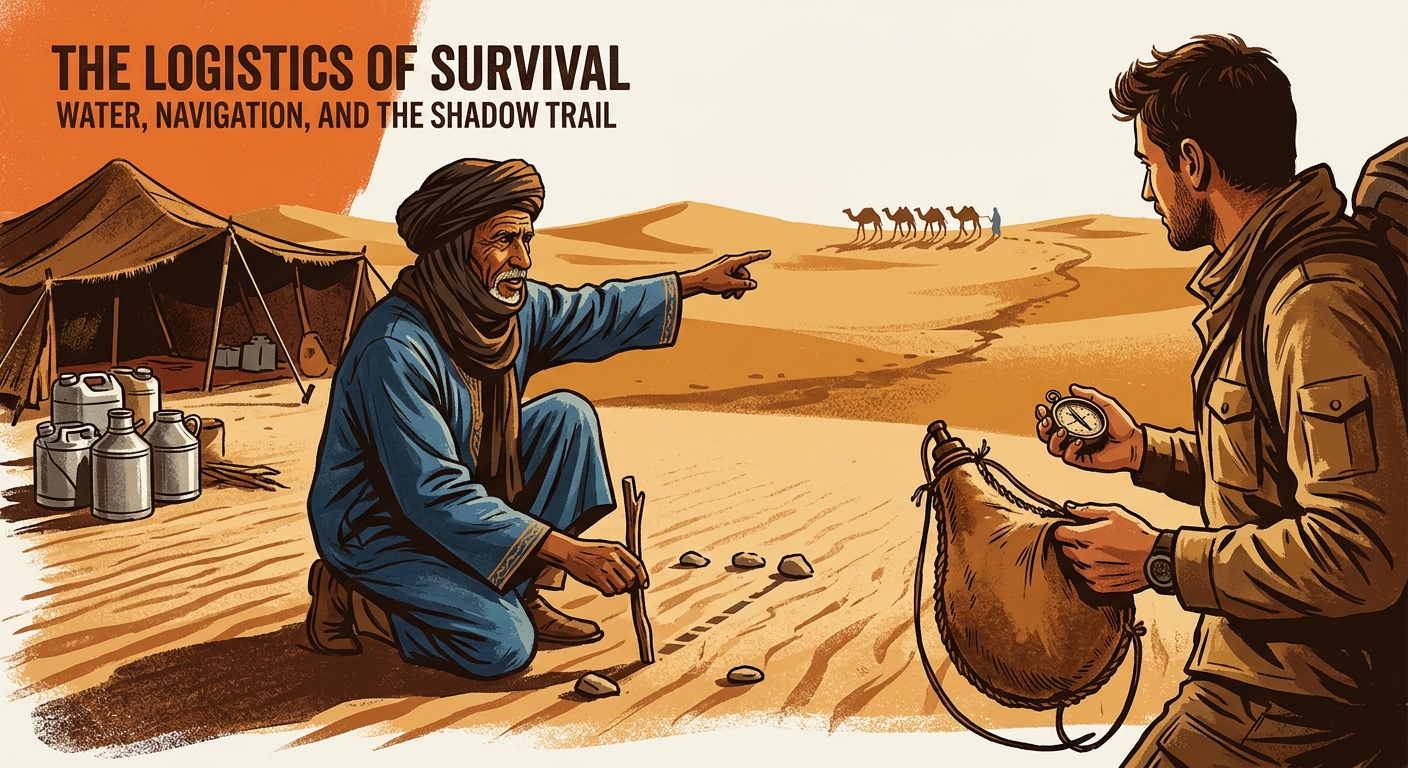
The Logistics of Survival: Water, Navigation, and the Shadow Trail
Most commercial tours gloss over the severe realities of the desert, leaving a massive gap in technical preparation for the independent or adventure-minded traveler. The cornerstone of desert survival logistics is what local guides call the "Logistics of the Shadow"—the strategic movement between shade and water sources without relying on modern infrastructure.
Finding water in a seemingly barren landscape is a heavily guarded art. A recent BBC Travel report detailed how elite nomad guides "decode" the Sahara's secrets, reading subtle environmental cues—like the flight paths of specific birds or the moisture content in the roots of a Tamarix tree—to locate hidden wells [3]. At Morocco Safari, our on-the-ground operational knowledge reinforces this: water management in the Sahara dictates every route, determining how far a caravan can push before requiring replenishment. For those looking to understand how these movements are orchestrated over longer periods, exploring a detailed 7-day Sahara logistics plan provides crucial insight into the cadence of authentic desert travel.
GPS vs. Ancestral Tracking: How to Find Your Way
In an era dominated by satellites, understanding traditional desert navigation is a revelation. While modern expeditions carry GPS as a safety protocol, relying on it strips the journey of its soul.
Nomads excel at navigation without GPS by utilizing a complex matrix of natural indicators. During the day, they read the orientation of sand ripples, which are carved by prevailing seasonal winds, to maintain a straight bearing. By night, desert navigation techniques shift to the stars. The celestial map has guided caravans for centuries, offering unshakeable fixed points when the physical landscape shifts overnight in a sandstorm.
The Nomad’s Mindset: Etiquette and Cultural Protocols
Venturing off the grid is as much a psychological journey as a physical one. To truly experience the Sahara, one must adopt the nomad's mindset for off-grid living. The desert’s social fabric is woven with unwritten rules of interaction. Understanding this desert etiquette ensures your presence is met with respect rather than tolerance.
A study by Columbia University on the interdependence of nomad communities emphasizes that survival in extreme environments relies heavily on mutual aid and strict social codes [4]. These nomadic social codes are recognized globally, with UNESCO actively working to protect the intangible cultural heritage of these regions, acknowledging that these traditions are as fragile as the physical environment [5].
The Three Teas: Understanding Saharan Hospitality
Central to this social fabric is the Saharan tea ritual, a cornerstone of desert hospitality. If you are invited into a nomadic encampment, you will be served tea. This is not merely a refreshment; it is a complex negotiation of trust.
The Berber tea ceremony traditionally involves serving three distinct glasses. As the local proverb goes: The first glass is as bitter as life; the second is as strong as love; the third is as gentle as death. Accepting all three glasses is mandatory protocol. It demonstrates patience, respect for the host's resources, and a willingness to sit and share time—the most valuable currency in the desert.
Equipment for Immersion: Gear Beyond the Tourist Catalog
The gear required for a multi-day trek bears little resemblance to the fashion-forward "safari" clothing sold in tourist markets. Technical desert equipment prioritizes durability, sun protection, and sand-proofing over aesthetics.
According to the ethical trekking specialists at Walking With Nomads, a true Saharan packing list eschews modern synthetic activewear for loose, tightly woven cotton garments that allow air circulation while blocking UV rays and blowing sand [6]. Desert trekking gear must also include specialized footwear (often flat, wide-soled boots or traditional leather sandals for the dunes), polarizing sunglasses with side shields, and a cheche or tagelmust—the traditional turban that serves as a hat, scarf, mask, and towel.
Managing the Elements: Sand, Sun, and Storms
The desert is an environment of extremes. Proper desert temperature management requires a layering system capable of handling 45°C (113°F) midday highs and near-freezing nighttime lows.
Equally critical is sandstorm safety. When the Sirocco or Chergui winds howl, the horizon vanishes in a wall of abrasive dust. Protocol dictates immediately seeking the leeward side of the largest stable dune, wrapping the face entirely in the cheche, protecting electronics in specialized dry-bags, and waiting with patience. In the Sahara, you do not fight the elements; you yield to them.
Planning Your Off-Trail Expedition: Itineraries That Don't Exist
The most transformative desert experiences happen far beyond the standard Merzouga-to-Zagora tourist loops. Custom Sahara tours allow travelers to access remote Ergs and ancient transhumance routes that rarely appear on standard maps.
To plan off-trail Sahara treks, you must look toward the wilder frontiers. Publications like National Geographic Travel often highlight the staggering, remote geography of the deep Moroccan south, where the dunes of Erg Chigaga stretch untouched for miles, accessible only by a grueling multi-day camel trek or highly skilled 4x4 navigation [7]. By requesting authentic desert itineraries that bypass the crowded camps, you engage with the landscape on its own terms. Whether you are looking for an extended expedition or a concentrated, authentic Merzouga desert expedition, the key is prioritizing isolation and localized knowledge over convenience.
Truth in Guiding: How to Spot a Genuine Nomad Guide
A significant challenge for modern travelers is consumer trust. As tourism booms, the prevalence of Sahara tour scams—where city-based operators don traditional robes to play the part of a nomad—has skyrocketed.
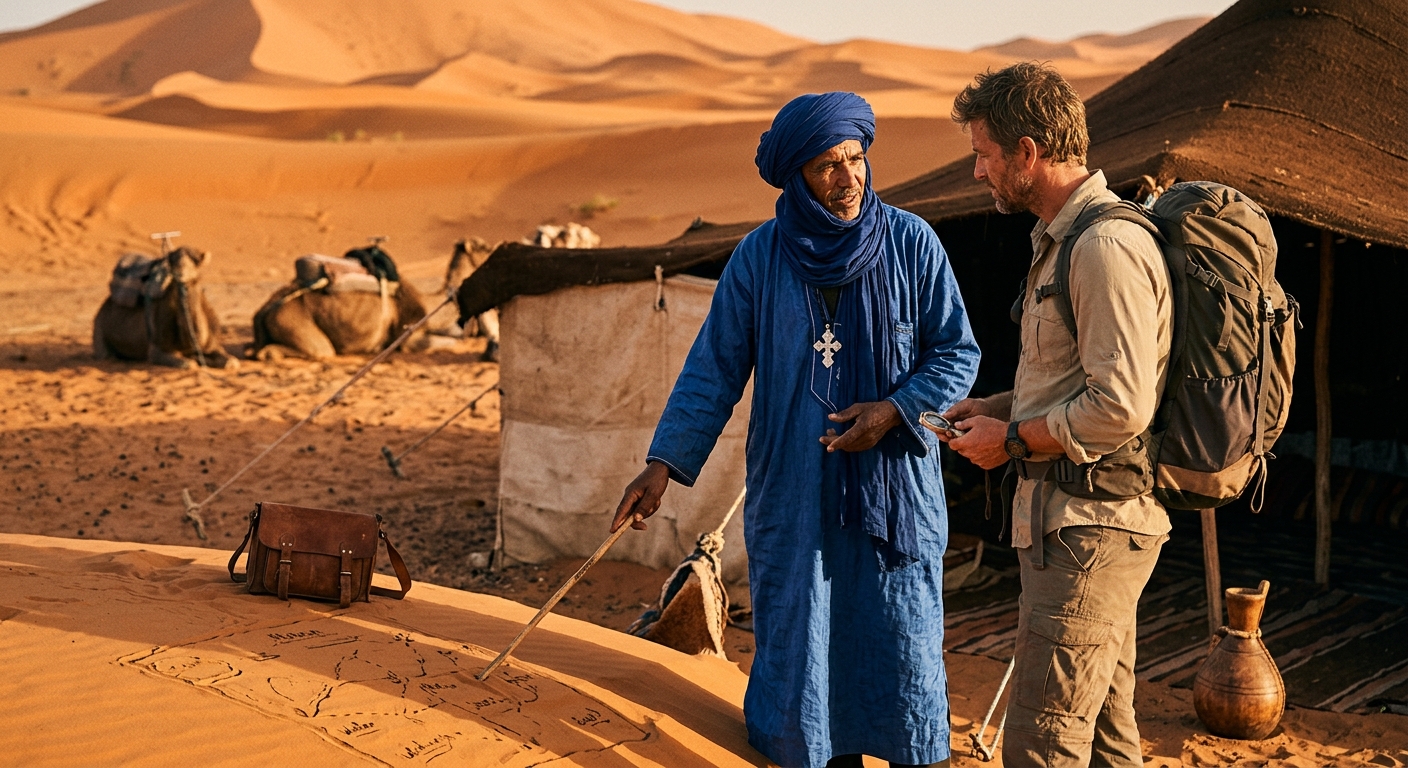
So, how do you find authentic nomad guides? First, verify their lineage and local knowledge. A genuine guide from the region will have an intimate, encyclopedic knowledge of local tribal affiliations, well locations, and seasonal weather patterns. Second, check for official licensing. The Moroccan Ministry of Tourism enforces strict guidelines on who can legally operate as a guide [8].
Officially accredited by the Moroccan Ministry of Tourism, Handicrafts and Social Economy under official licensing, certifying Morocco Safari as an authorized travel provider for the Saharan regions.
When finding a desert guide, transparency is paramount. Reputable agencies will happily discuss the breakdown of their fees, ensuring fair wages for the camel handlers and camp staff. For more insight into this, we recommend understanding desert tour pricing and logistics before booking your expedition.
Ethical Tourism and the Future of the Sahara
The influx of global travelers brings economic opportunity but also severe environmental strain. Sustainable desert tourism is no longer optional; it is a critical mandate to ensure the Sahara remains pristine for future generations.
Eco-friendly Sahara travel means choosing operators that prioritize zero-waste camps, utilize solar power, and actively engage in supporting nomad communities through fair employment and localized sourcing.
This tour package complies with the Global Sustainable Tourism Council (GSTC) safety and sustainability protocols as verified by international standards [10], and adheres to the strict guidelines set forth by the Adventure Travel Trade Association (ATTA) [9].
By demanding ethical practices, travelers can ensure that their presence does not erode the very culture and landscape they came to witness.
Conclusion
Ready for a truly off-grid experience? Explore our custom Sahara expeditions designed with authentic nomadic logistics.
The "Nomad's Secret" is not a singular revelation, but a profound combination of deep respect for tradition and meticulous, technical logistical preparation. The Sahara is not a playground. It is a formidable, living, breathing culture that swiftly punishes the arrogant but generously rewards the patient and the prepared. By stepping off the commercial trail, embracing the ancestral etiquette, and trusting genuine local expertise, you cross the threshold from a mere tourist to a true traveler of the sands.
References and Authoritative Sources
[1] Britannica - Sahara - Nomads, Bedouins, Tuareg - https://www.britannica.com/place/Sahara-desert-Africa/People [2] PMC (National Center for Biotechnology Information) - Oases in the Sahara Desert–Linking biological and cultural diversity - https://pmc.ncbi.nlm.nih.gov/articles/PMC10434913 [3] BBC Travel - The nomad guide who decodes the Sahara's secrets - https://www.bbc.com/travel/article/20210906-the-nomad-guide-who-decodes-the-saharas-secrets [4] Columbia University - Mali's Nomads: Bulwarks Against Jihad - https://ciaotest.cc.columbia.edu/journals/wpj/v31i3/f_0033091_26943.pdf [5] UNESCO World Heritage Centre - Morocco State Parties - https://whc.unesco.org/en/statesparties/ma [6] Walking With Nomads - Ethical Desert Trekking, ECO Activities & Tours in Morocco - https://www.walkingwithnomads.com [7] National Geographic Travel - Morocco Destinations Guide - https://www.nationalgeographic.com/travel/destinations/africa/morocco/ [8] Moroccan Ministry of Tourism, Handicrafts and Social Economy - Tourism Regulation and Licensing - https://mtpnet.gov.ma/en/ [9] Adventure Travel Trade Association (ATTA) - Adventure Travel Standards - https://www.adventuretravel.biz/ [10] Global Sustainable Tourism Council (GSTC) - Eco-Tourism and Safety Standards - https://www.gstcouncil.org/